Keep the lights on when the grid can't.
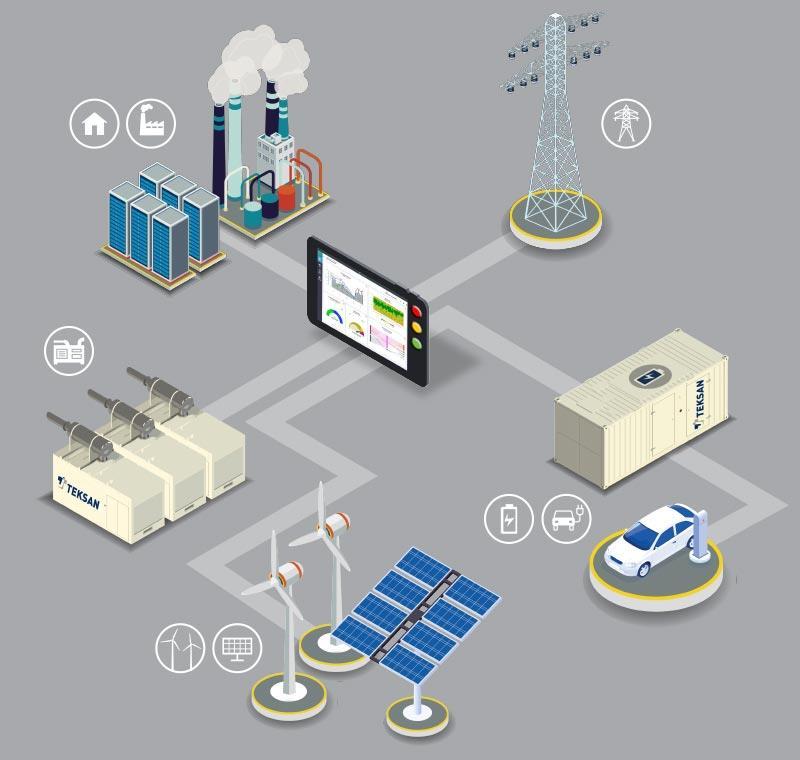
Solstice microgrids combine solar, battery storage, and control software into one system that islands automatically — keeping critical loads powered through any grid event.
From critical-load assessment to a system that islands itself.
Every microgrid starts with a clear answer to one question: what absolutely cannot lose power, and for how long.
Critical load assessment
We identify must-run loads, review your single-line diagram, and confirm the interconnection point with your utility.
System design & controls
Solar, battery, and generator assets are sized together, with dispatch and islanding logic programmed to your site.
Installation & integration
Equipment is installed and integrated with your existing switchgear and any distributed energy resources already on site.
Commissioning & handover
Island-mode is tested under real conditions before handover, with 24/7 monitoring live from day one.
A matched set of components, not a pile of parts.
Each layer of a Solstice microgrid is engineered to work with the others — sizing one piece independently is usually where DIY microgrids go wrong.
Built for sites where downtime isn't an option.
Every microgrid is scoped around the loads that matter most at your site, not the whole facility by default.
Campuses & universities
Keep dorms, labs, and research equipment running through regional outages.
Hospitals & critical facilities
Zero-gap backup for life-safety systems, beyond what standby generators alone provide.
Industrial & manufacturing parks
Protect production lines from voltage sags and outages that cost far more than the power itself.
Remote & island communities
Reliable power for communities where the nearest grid connection is unreliable or far away.
What would keep your critical loads running?
Set your critical load and how many hours it needs to ride through an outage — this sizes the battery and solar array in whole system terms.
What it looks like when the grid actually goes down.
Two utility outages since commissioning. Neither one was noticeable inside the building — monitoring caught both before our staff did.
We kept dorms and the data center running through a multi-hour regional outage without touching the backup generator.
A voltage sag that used to mean a full line restart now just passes through the microgrid without anyone noticing on the floor.
What facility teams ask before committing.
The controller detects the outage, disconnects from the grid, and re-energizes your critical loads from battery and solar — typically in under 100 milliseconds, with no manual switching.
Yes — the assessment stage specifically evaluates your existing distributed energy resources and designs the controller to incorporate them rather than replace them.
We work with your facilities team to walk through every circuit and agree on what must stay powered — this becomes the baseline the entire system is sized against.
Every system ships with 24/7 remote monitoring from our operations center, with alerts sent to your team before an issue affects uptime.
Find out what your site needs to stay powered.
Free critical-load assessment, with a real system design — not a generic package.

