
The UAE has some of the best solar conditions in the world, and some of the most demanding electricity use. Cooling alone can account for most of a villa or office building’s consumption through the long summer, and the peak of that demand lands in the late afternoon and evening, just as solar output falls away. The sun produces power when the building needs it least and stops when it needs it most.
An energy storage solution closes that gap. It captures electricity when it is plentiful, from rooftop solar or the grid, and releases it when it is needed: in the evening, during a peak-demand window, or when the supply is interrupted. This guide explains how storage works, what the technology looks like in UAE conditions, and how homeowners, commercial buildings and industrial sites across Dubai, Abu Dhabi, Sharjah, Ajman, Umm Al Quwain, Ras Al Khaimah and Fujairah can size and specify a system that does what they actually need.
Why the UAE Needs Storage, Not Just Solar
Three conditions make storage more relevant here than in most markets:
- Solar and demand are out of step. Rooftop PV peaks around midday. Air conditioning load peaks in the late afternoon and evening, and many homes and businesses see their highest consumption after solar output has dropped. Without storage, that evening demand is met entirely from the grid or a generator.
- Export is not the same as value. In Dubai, the Shams Dubai programme lets eligible rooftop systems export surplus power to the DEWA grid and receive bill credits through net metering. That works well, but stored energy lets a property use more of its own generation on site, which matters most where export is limited or where resilience is the priority.
- Continuity has a cost. A short outage at a villa means spoiled food and no cooling. At a business it can mean lost trading time, stopped production or corrupted data. Storage gives selected loads a source of power that does not depend on the grid being up.
Dubai’s own clean energy strategy targets 75% of the emirate’s power from clean sources by 2050, and distributed solar on buildings is a stated part of that plan. As rooftop solar becomes standard, storage is the natural next layer.
What Are Energy Storage Solutions?
An energy storage system (ESS) is a set of equipment that stores electrical energy and supplies it on demand. A system receives electricity from solar generation or the grid, holds it in batteries, and discharges it to connected loads when required.
In practical terms the idea is simple: generate or receive power, store the surplus, use it when it is needed. Depending on the application, a system can:
- Store surplus solar electricity for use after sunset
- Provide backup power to selected loads during a grid outage
- Reduce demand drawn from the grid during peak periods (peak shaving)
- Support EV charging without overloading the building’s supply
- Add resilience and flexibility to commercial and industrial sites
The important part is matching the system to the way electricity is actually used.
How an Energy Storage System Works
Although systems vary by size and application, the basic process has four stages.
1. Electricity is generated or supplied
Power enters the system from rooftop solar, the DEWA, SEWA, FEWA or other utility grid, or both. A hybrid inverter typically manages the interface between solar, battery, grid and the building’s loads.
2. Surplus energy is stored
When more electricity is available than is being used, the surplus is directed into the battery rather than being exported or wasted.
3. The system manages power flow
A battery management system (BMS) protects the cells, and an energy management system (EMS) decides when to charge and when to discharge based on generation, consumption and the priorities that have been set.
4. Stored energy is used
When solar output falls, demand peaks or the grid goes down, stored energy is released to the connected loads. In a backup configuration, the transfer happens automatically.
Key Benefits of Energy Storage in UAE Conditions
Better use of solar energy
Solar power is produced when the sun is out, and consumption does not stop at sunset. Storage lets a property keep more of what its panels generate and use it in the evening. For homeowners and businesses already running residential solar or commercial solar, storage is the component that turns daytime generation into round-the-clock supply.
Backup power when the grid is unavailable
A properly configured system supports selected loads during an outage. Backup duration depends on two things: how much energy the battery holds and how much power the connected equipment draws. A system sized to keep lighting, networking, refrigeration and a few essential circuits running will last far longer than one expected to carry every air conditioner in the building.
Peak shaving and demand management
Commercial and industrial sites can discharge the battery during high-demand periods so that less power is drawn from the grid at the moment demand is highest. Where a facility is charged on demand, this can reduce the peak the utility sees. The benefit depends entirely on the site’s load profile, which is why sizing should start with data and not with a battery size.
Greater energy resilience
Storage does not remove every power risk, but it adds a second source of available energy and forms part of a wider resilience strategy alongside UPS systems, generators and voltage regulation.
Energy Storage for Homes and Villas
For homeowners, the first question should not be “how big a battery should I buy?” A better starting point is “what do I need the stored energy to do?”
A villa owner who mainly wants to use more solar in the evening needs a different configuration from one who wants the fridge, lights, Wi-Fi and a couple of air conditioners to keep running through a cut. Both can be served by a battery, but the capacity, the output power and the circuits wired to the backup supply will differ.
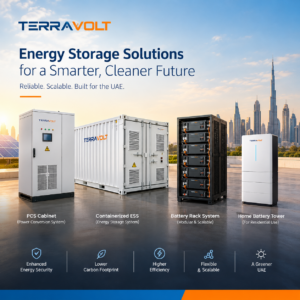
Terravolt’s residential energy storage systems use LiFePO4 (lithium iron phosphate) cells in a modular, wall-mount or floor-standing format, with usable capacity from 5 kWh to 40 kWh in stackable steps. The published specification lists 5 kW continuous output, an IP65 rating for indoor or outdoor mounting, fanless natural convection cooling, and an operating range of -20 to 50 degrees C.
Before choosing a residential system, consider:
- Average daily and monthly electricity consumption, and when it occurs
- Installed or planned solar capacity
- Which circuits must stay on during an outage
- How many hours of backup are actually needed
- Available installation space, indoors or in a shaded outdoor location
- Future changes, such as an EV charger or a pool
Table 1: Residential energy storage system – published specification
Parameter | Specification |
Usable capacity | 5 kWh / 10 kWh / 20 kWh / 40 kWh (stackable) |
Battery chemistry | LiFePO4 (lithium iron phosphate) |
Continuous output power | 5 kW (10 kW peak) |
Nominal voltage | 51.2 V DC |
Round-trip efficiency | 95% or higher |
Cycle life | 6,000+ cycles at 80% depth of discharge |
Protection rating | IP65 |
Operating temperature | -20 to 50 degrees C |
Cooling | Natural convection (fanless) |
Mounting | Wall-mount or floor-standing |
Communication | Wi-Fi, app monitoring, RS485 |
Certifications | CE, UN38.3, RoHS |
Energy Storage for Commercial Buildings
Businesses usually have more complicated electricity requirements than homes. An office, retail unit, warehouse or mixed-use building may run different loads at different times, with some equipment needing continuous power and other loads running only in business hours.
Commercial energy storage can be part of a wider strategy that includes solar generation, backup power, demand management and operational continuity. A business with a rooftop array will generate surplus at midday and keep consuming after solar output falls; storage connects those two periods.
Terravolt’s commercial and industrial energy storage systems are built on LiFePO4 chemistry in four capacity tiers: 100 kWh, 250 kWh, 500 kWh and 1 MWh, with the platform stackable beyond 1 MWh. The published specification lists 50 kW continuous output (100 kW peak), a 768 V DC nominal voltage, 94% or higher round-trip efficiency, an IP54 enclosure and an operating range of -20 to 55 degrees C.
Table 2: Where each commercial and industrial capacity tier fits
Capacity tier | Typical application | Role of storage |
100 – 250 kWh | Retail and small commercial sites | Trim demand charges and keep essential systems running through short outages. |
250 – 500 kWh | Warehouses and light manufacturing | Store off-peak or on-site solar energy to offset high daytime load. |
500 kWh – 1 MWh | Large facilities and data centres | Critical load continuity plus meaningful demand reduction at scale. |
1 MWh and above | Industrial plants and microgrids | Multi-container deployments for sites that cannot tolerate grid interruption. |
Industrial Energy Storage: Why System Design Matters
Industrial sites have substantial power requirements and equipment that behaves very differently from a residential property. Manufacturing facilities, processing operations, logistics hubs and infrastructure projects need storage that accounts for:
- Power demand and required storage capacity
- Operating schedules and shift patterns
- Backup requirements and which processes are critical
- Existing electrical infrastructure and protection
- Future expansion
At this scale, storage is part of the site’s power architecture and not a standalone component. It has to work with the existing switchgear, generators, UPS systems and any voltage stabilization on the site. For data facilities, see Terravolt’s sustainable datacenter solutions; for sites that want a self-sufficient network, see microgrid solutions.
Indoor or Container? Choosing the Format
This is a decision that deserves more attention than it usually gets, because it determines where the system lives, how it is cooled and what it needs from the site.
Indoor systems
- Suited to buildings with a dedicated electrical room, plant room or basement with controlled conditions. See Terravolt’s ESS indoor solutions.
- Keeps the batteries out of direct sun and sand, and makes cooling more predictable.
- Needs adequate ventilation, clearances, fire separation and access for maintenance.
- Space is the usual constraint, particularly in existing buildings.
Containerized systems
- Pre-integrated units designed for easy deployment and scalability on commercial and industrial sites. See Terravolt’s ESS container solutions.
- Suited to large capacities, industrial yards and sites with no suitable indoor space.
- Thermal management is critical because the unit sits in the UAE sun. Liquid cooling is specified on the larger tiers, and shading, orientation and ventilation planning all matter.
- Coastal sites in Ajman, Umm Al Quwain, Ras Al Khaimah, Fujairah and the Abu Dhabi coastal strip should specify corrosion protection with salt-laden air in mind.
Heat, Dust and Humidity: Designing Storage for UAE Conditions
Battery performance and lifespan are sensitive to temperature, and the UAE is a harder environment than the datasheet conditions many systems are tested in. Four points are worth raising at specification stage:
- Sustained heat accelerates cell ageing. Check the operating range against the real ambient at the installation point, not the weather forecast, and remember that a closed container or an unventilated plant room can run far hotter than the outside air.
- LiFePO4 is widely used for stationary storage because of its thermal stability and long cycle life. For some standby and solar applications, solar GELand VRLA batteries remain relevant, and the full range is covered under industrial batteries and lithium-ion battery systems.
- Ingress protection. Dust and sand are routine. An IP54 or IP65 rated enclosure matters outdoors, and filters and fans on air-cooled equipment need a maintenance plan.
- Shade, airflow and distance from heat sources matter as much as the nameplate rating. A well-chosen location is the cheapest way to extend battery life.
Energy Storage and Solar: How They Work Together
Solar and storage solve different parts of the same problem. Solar generates electricity; storage allows some of it to be saved for later. When a property generates more at midday than it is using, the surplus charges the battery. When production drops, the battery supplies the load.
The inverter is the link between them. A hybrid inverter manages solar, battery and grid in one unit, which suits most grid-connected homes and businesses. Where there is no grid connection, or the site must operate independently, an off-grid inverter and battery bank form the core of an off-grid solar solution.
Approvals and Standards: What to Check in the UAE
Requirements differ by emirate and by project, so treat the following as a checklist of questions to raise early, not as a substitute for the authority’s current rules.
- Utility approval. In Dubai, grid-connected solar goes through DEWA’s Shams Dubai programme using an accredited contractor. If a battery is part of the project, confirm DEWA’s current requirements for battery storage before fixing the specification. Other emirates have their own utility processes through SEWA, FEWA and Etihad WE, and Abu Dhabi has its own self-supply framework.
- Civil Defence. Battery installations typically need fire and life-safety approval, with requirements for location, separation, detection and suppression. Raise this at design stage, not at handover.
- Product certification. Look for recognised safety and transport certification on the equipment. Terravolt’s residential specification lists CE, UN38.3 and RoHS, and the commercial specification adds UL 9540.
- Export rules. Net metering credits generally apply to solar generation, not to battery discharge, so check how the system will be configured to charge and discharge before assuming a particular financial outcome.
How to Choose the Right Energy Storage System
There is no single storage size that suits every property. Work through these factors in order.
1. Your electricity consumption
Look at how much electricity the property uses and, more importantly, when. Monthly DEWA, SEWA or ADDC bills are a start; interval data is better. Summer and winter profiles in the UAE differ sharply, so size against the demanding season.
2. Your peak power requirement
Two properties can use the same total energy but have very different peaks. The system has to deliver the power the equipment draws, not just hold enough energy. Air conditioning compressors and pumps have high starting currents that need to be accounted for.
3. Your backup requirements
Decide what must stay on during an outage. Backing up everything is rarely necessary and is the fastest way to oversize a system. Prioritising essential circuits changes the required capacity dramatically.
4. Your solar generation
If the system will connect to solar, consider how much the array produces and when. That determines how much surplus is available to charge the battery and how it should be used.
5. Your future needs
A business may expand, a household may add an EV charger or a pool, a facility may increase production. Modular, stackable systems let capacity grow with demand. If you are adding vehicle charging, see Terravolt’s EV charger solutions so the two can be planned together.
Why Professional Energy Storage Design Matters
Battery capacity is only one part of an energy storage project. The system also has to work with the property’s electrical infrastructure, power requirements, generation sources and intended operating pattern. A proper assessment looks at:
- Current consumption and peak demand
- Required backup duration and critical loads
- Solar generation and inverter compatibility
- Storage capacity and power rating
- Installation conditions: heat, ventilation, space, access
- Approvals, protection and integration with existing systems
Terravolt offers energy audit and consultation services for exactly this stage. It turns energy storage from a simple battery purchase into a planned energy solution.
Energy Storage as Part of a Wider Power System
Storage works best alongside other technologies. Terravolt’s portfolio covers energy storage, solar inverters, industrial batteries, UPS systems, outdoor voltage stabilizers, solar-powered solutions and EV charging, supplied and supported across the UAE through its UAE services.
A UPS protects sensitive equipment through a split-second interruption, a stabilizer corrects voltage, and an energy storage system provides longer-duration energy. They do different jobs, and larger sites often use all three. Designing them together avoids gaps and duplicated cost.
Across the Seven Emirates
The engineering is the same everywhere in the country. The practicalities are not.
Villa and community projects in Dubai and Abu Dhabi are typically driven by solar self-consumption and backup, and favour compact wall-mount or floor-standing residential systems. Commercial buildings in the same cities usually need a design that respects plant room space, Civil Defence requirements and utility approvals. Industrial work in Sharjah, Ajman and the Ras Al Khaimah industrial zones more often points toward containerized systems with robust thermal management. Coastal sites in Fujairah, Umm Al Quwain and Ajman need enclosure and finish specified with salt in mind. Remote sites with no grid connection are the clearest case for solar plus storage.
Frequently Asked Questions
What are energy storage solutions?
Energy storage solutions are systems that store electrical energy so it can be used later. They can be integrated with rooftop solar, the electrical grid and other energy infrastructure, and they range from compact home batteries to containerized systems for industrial sites.
Can energy storage work with solar panels in the UAE?
Yes. Storage is commonly paired with rooftop solar to store surplus daytime generation for use in the evening. A hybrid inverter normally manages the flow between panels, battery, grid and loads. In Dubai, grid-connected solar goes through DEWA’s Shams Dubai process, so confirm the requirements for adding a battery before finalising the design.
Can a battery run my air conditioning during a power cut?
It can, but air conditioning is a high-power load, so it is the main driver of battery size. Backup duration depends on stored energy and on how much power the connected equipment draws. Backing up lighting, networking and refrigeration is far more economical than backing up every air conditioner. A load assessment will tell you what is realistic.
Does heat affect battery storage in the UAE?
Yes. High temperatures accelerate battery ageing, so the installation location, ventilation and cooling method matter. Choose equipment whose rated operating range covers the real conditions at the installation point, and place it in shade or in a ventilated, controlled space wherever possible.
Are energy storage systems suitable for businesses?
Yes. Commercial energy storage can support backup requirements, solar integration, peak demand management and operational continuity. The system should be sized from the building’s actual load profile, not from a standard configuration.
How do I know what size energy storage system I need?
Start with your electricity consumption, peak power requirement, backup priorities, solar generation and the loads you want to support. A professional assessment then determines the capacity and power rating. Send us your recent bills or load data and our team will recommend a configuration.
Can energy storage be used for industrial applications?
Yes. Industrial energy storage can be incorporated into larger power systems, and containerized configurations suit large capacities. Industrial projects need careful consideration of power demand, storage capacity, operating conditions, existing infrastructure and future expansion.
Do I need approval to install a battery system in the UAE?
Usually, yes. Grid-connected systems need the relevant utility’s approval, and battery installations typically also involve Civil Defence requirements. These differ between emirates and projects, so check the current rules with the authority or your contractor before purchase.
What is the difference between a UPS and an energy storage system?
A UPS provides instant, short-duration backup to protect sensitive equipment from interruptions and power quality problems. An energy storage system holds much more energy for longer-duration use, such as evening solar supply, peak shaving or extended outages. Many sites use both.
Why Work With Terravolt Energy
Terravolt Energy Systems LLC is headquartered in Dubai and supplies energy and power equipment across the UAE and the wider Middle East and Africa region. For a storage project, that breadth matters: the battery, the inverter, the UPS, the stabilizer, the solar array and the EV chargers can come from one supplier with one point of technical contact, and the whole system can be designed to work together.
Our team starts from the property’s actual load profile and objectives, not from a standard configuration, and offers energy audits and consultations where the requirement is not yet clear. See the full range of power solutions and services in the UAE.
Get an Energy Storage System Specified for Your Property
If you are planning solar and storage, or need dependable backup power for a home, commercial building or industrial site anywhere in the UAE – Dubai, Abu Dhabi, Sharjah, Ajman, Umm Al Quwain, Ras Al Khaimah or Fujairah – talk to us before you choose a battery size. Send your recent electricity bills or load data, the loads you want to protect, any existing or planned solar capacity and the installation location, and our engineers will come back with a sized recommendation. Contact the Terravolt team or call +971 56 539 8618.
Terravolt Energy Systems LLC – Energy storage, solar, UPS, stabilizers and EV charging solutions, supplied and supported across the UAE. Visit terravoltenergy.com or contact our technical team for a site-specific recommendation.
