
If you walk through any industrial zone in Dubai, Abu Dhabi, or Sharjah during the summer, utility bills are the number one headache plant managers talk about. Between May and October, running heavy extrusion lines, blast freezers, cold storage blowers, and central chillers pushes electrical demand to extreme peaks. For many manufacturing facilities, electricity isn’t just an operational overhead; it’s their largest single recurring expense.
Historically, factories relied entirely on the utility grid, absorbing painful peak tariff slabs and fuel adjustment surcharges. But over the last two years, the economic calculation in the GCC has flipped completely. With high solar irradiance averaging over 2,100 kWh per square meter per year and battery pack pricing dropping to historic lows, forward-looking industrial operators are taking control of their power. By combining turnkey commercial solar solutions with scalable containerized energy storage systems, UAE businesses are slashing total electricity costs by up to 68%, eliminating peak demand penalties, and securing reliable power continuity during grid disturbances.
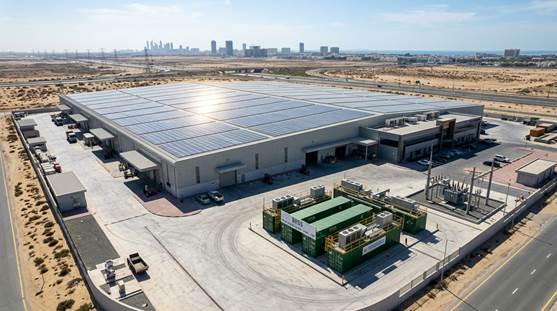
Commercial manufacturing plant in the UAE equipped with expansive rooftop solar PV arrays and a multi-megawatt containerized battery energy storage system (BESS).
ALT: Commercial solar and containerized battery energy storage facility UAE | Filename: commercial-solar-bess-uae-facility.jpg
The Financial and Electrical Case for Industrial Solar in the UAE
Solar power in the Gulf is no longer an ESG vanity project; it is an aggressive cost-reduction strategy. In manufacturing clusters like Dubai Industrial City, JAFZA, KIZAD, and Mussafah, industrial power tariffs follow time-tested consumption slabs. The more power your machinery draws during hot daylight hours, the higher into premium tariff brackets you climb.
Three financial and operational dynamics make commercial rooftop solar exceptionally compelling across the Emirates:
1. Unmatched Solar Resource: The UAE receives between 8 to 10 hours of intense direct sunlight daily. An optimized commercial rooftop installation generates approximately 1,600 to 1,800 kWh of clean electricity per kWp installed annually, outperforming European installations by more than 70%.
2. Load Profile Synchronization: In commercial and industrial facilities, peak electrical demand occurs between 11:00 AM and 4:00 PM when ambient temperatures peak and HVAC chillers run at 100% capacity. This coincides perfectly with peak solar photovoltaic generation, allowing self-generated power to offset the most expensive utility units.
3. DEWA Shams Dubai Net Metering: In Dubai, approved commercial solar installations connect directly to the utility grid under the Shams Dubai initiative. Surplus power generated during weekends or light production shifts feeds into the grid, producing credits that offset nighttime consumption on a 1-to-1 kWh basis.
Why Commercial Rooftop Solar Alone Is Not Enough for High Demand Industrial Sites
While rooftop solar panels deliver immense savings during sunny midday hours, solar generation is fundamentally intermittent. A passing dust cloud or afternoon haze can drop solar output by 30% in seconds. More importantly, industrial manufacturing doesn’t stop at sunset.
The Peak Demand Tariff Penalty in Dubai and Abu Dhabi
Industrial utility bills in the UAE are not calculated solely on total kilowatt-hours (kWh) consumed. A substantial portion of the invoice is determined by your maximum peak demand (kVA). If an industrial plant starts up multiple heavy 250 kW motors or large compressor banks simultaneously, the instantaneous electrical spike sets a new monthly peak demand threshold. Utility providers bill your facility based on that highest recorded spike, even if it lasted for only fifteen minutes. Solar panels cannot prevent a morning or evening demand spike if the sun isn’t shining at full capacity.
Night Shift Loads and Continuous Manufacturing Schedules
Plastics manufacturers, food packaging lines, pharmaceutical plants, and cold storage hubs run 24 hours a day, 7 days a week. After 6:00 PM, a solar-only installation produces zero watts. The facility reverts entirely to drawing grid electricity during evening shifts. To capture true energy independence and protect machinery around the clock, facilities must store low-cost solar electricity generated during midday for dispatch during peak evening production shifts.
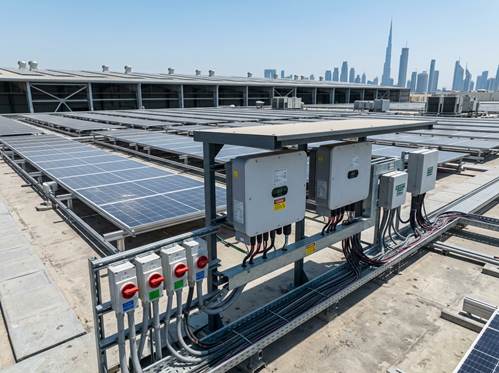
Commercial rooftop solar PV array in Dubai with high-efficiency bifacial panels and industrial string inverters mounted with shaded cable management.
ALT: Commercial rooftop solar panels and string inverters on Dubai warehouse | Filename: rooftop-solar-inverters-dubai-warehouse.jpg
How Containerized Battery Energy Storage Systems Bridge the Generation Gap
This is where modern utility-grade Battery Energy Storage Systems (BESS) transform facility economics. By coupling rooftop solar arrays with heavy-duty ESS container solutions or dedicated indoor battery rooms, industrial operators create a private, self-balancing energy microgrid right on site.
Peak Shaving and Demand Response with Lithium Iron Phosphate Technology
Modern industrial BESS units utilize high-safety Lithium Iron Phosphate (LiFePO4) chemistry. When facility demand spikes as large chiller compressors or extrusion lines start up, the BESS automatically discharges power in milliseconds, capping the maximum load seen by the utility meter. This process—known as peak shaving—flattens the facility’s demand curve, saving hundreds of thousands of dirhams annually in peak demand penalties. During off-peak or midday hours when solar generation exceeds internal consumption, the surplus energy charges the battery banks rather than being exported at discounted wholesale rates.
Microgrid and Islanding Capability During Grid Disconnects
Beyond tariff savings, a containerized BESS acts as an enterprise power shield. Standard grid-tied solar inverters are legally required by utility anti-islanding regulations to shut down instantly if the municipal grid drops out. However, when paired with intelligent hybrid inverters and our microgrid solutions, the BESS forms its own local voltage and frequency reference. If a grid blackout occurs, the system smoothly transitions into island mode in less than 20 milliseconds, keeping critical machinery running on stored solar energy without disruption.
Table 1: Industrial Power Infrastructure Comparison across Operational Parameters
| Operating Metric | Grid-Only Industrial | Commercial Rooftop Solar Only | Solar + Indoor BESS (100-500 kWh) | Solar + Containerized BESS (1-5+ MWh) |
| Daytime Cost Reduction | 0% (Full tariff exposure) | 40% to 55% during sunlight | 50% to 65% with load shifting | Up to 68% total energy reduction |
| Peak Demand (kVA) Shaving | No protection | Only if peak matches noon sun | Moderate peak shaving capacity | Full automated peak demand capping |
| Night Shift Solar Usage | Zero (Grid dependent) | Zero (Night grid tariffs apply) | Powers partial evening shift | Powers full continuous night shifts |
| Blackout / Islanding Backup | Zero (Requires diesel genset) | Zero (Inverters trip on grid loss) | Seamless backup for critical panels | Full facility islanded microgrid operation |
| Footprint & Housing | Standard MDB room | Rooftop structure only | Dedicated climate-controlled room | Self-contained outdoor ISO container |
| Typical Payback Period | N/A (Ongoing cost) | 3.5 to 5 years | 4 to 5.5 years | 3.8 to 5.2 years (High ROI) |
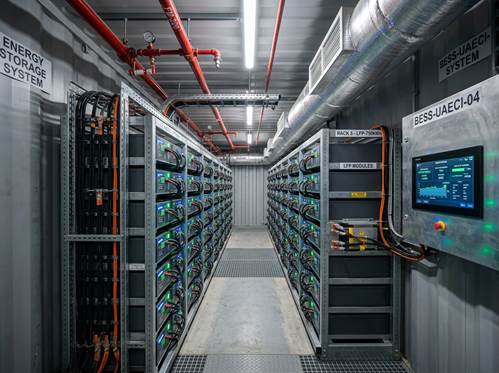
Interior of an industrial containerized BESS unit in the UAE featuring modular LiFePO4 battery racks, precision thermal HVAC, and FM-200 fire suppression.
ALT: Containerized BESS modular battery racks and climate control UAE | Filename: containerized-bess-battery-storage-uae.jpg
Table 2: Terravolt Commercial Solar & Containerized BESS Technical Specifications
| System Model / Package | Solar Array Capacity | BESS Storage Rating | Battery Chemistry | Round-Trip Efficiency | Cooling & Ingress Rating |
| Solar Industrial Eco 250 | 250 kWp Rooftop | 200 kWh Indoor Cabinet | LiFePO4 (Grade A prismatic) | >88% system round-trip | Forced air, IP20 indoor room |
| Solar MegaPack 500 | 500 kWp Rooftop | 500 kWh Outdoor Skid | LiFePO4 modular racks | >90% system round-trip | Integrated CCU cooling, IP55 |
| Terravolt BESS Container 1M | 500 kWp – 1.2 MWp | 1,000 kWh (1 MWh) ISO 20ft | Tier-1 LiFePO4 cells | >91% system round-trip | Precision HVAC + FM200, IP55 |
| Terravolt BESS Container 2.5M | 1.5 MWp – 3.0 MWp | 2,500 kWh (2.5 MWh) ISO 40ft | Liquid-cooled LiFePO4 | >92.5% system round-trip | Closed-loop liquid cooling, IP65 |
Integrating Clean Power with On-Site Fleet Electrification and EV Charging
As commercial logistics fleets and corporate vehicles transition to electric mobility, charging demand introduces massive new electrical loads. A fleet of twenty electric delivery vans charging simultaneously on 60 kW DC fast chargers adds 1.2 megawatts of sudden demand. If drawn straight from utility switchboards, this will trip incoming breakers or trigger astronomical demand charges. Working with certified EV charger suppliers in UAE allows businesses to deploy integrated solar carports with intelligent charging hubs.
Solar Carports and Commercial DC Fast Charging for Logistics Fleets
By building solar canopy structures over company parking bays and connecting them directly to a local BESS, vehicles charge on 100% self-generated solar power during the day. During evening return windows, the BESS discharges stored solar electricity into commercial DC fast chargers without pulling a single extra kilowatt from the utility grid.
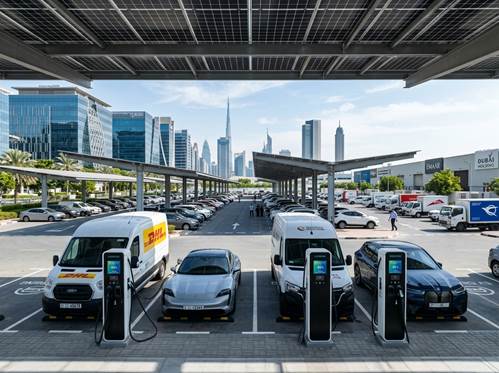
Commercial logistics fleet parking facility in Dubai featuring overhead solar panel carports and high-power DC fast EV charging pedestals.
ALT: Commercial solar carports and dual DC fast EV charging stations Dubai | Filename: commercial-solar-carport-ev-chargers-uae.jpg
Table 3: Commercial Solar Carport and EV Charging Station Specifications
| Charging Architecture | Charging Output | Connector Standard | Load Management Capability | CPO Integration Standard |
| Dual-Outlet Commercial AC | 22 kW + 22 kW Three-Phase | Type 2 Mennekes IEC 62196 | Dynamic solar tracking & load sharing | OCPP 1.6J / 2.0.1 compliant |
| Commercial DC Fast Charger | 60 kW to 120 kW Modular | CCS2 dual gun liquid-cooled | Automated BESS peak-shaving dispatch | OCPP billing & automated RFID |
| Ultra-Fast Fleet Depot Charger | 180 kW to 360 kW Split | Dual CCS2 high-amperage | Direct BESS DC-coupled bus | Automated fleet telematics billing |
Power Quality Considerations When Adding Heavy Solar and Inverter Loads
Adding a megawatt of rooftop solar inverters and fast-switching battery power converters fundamentally alters a plant’s electrical characteristics. Solar inverters switch DC to AC using high-frequency pulse width modulation (PWM). While modern Tier-1 inverters feature low total harmonic distortion, sudden changes in cloud cover or rapid load rejection can trigger transient voltage spikes and phase unbalances across the plant switchboard.
Preventing Voltage Surges with Industrial Servo Voltage Stabilizers
To protect sensitive CNC machines, automated robotics, and refrigeration compressor electronics from fluctuating solar-grid transitions, industrial facilities install heavy-duty voltage stabilizers. Consulting experienced stabilizer suppliers in UAE ensures that incoming voltage remains rigidly locked at 400V three-phase (+/-1%), while specifying weatherproof outdoor stabilizers in UAE guarantees that transformer-grade oil cooling protects active windings from harsh 50 degrees C desert ambient temperatures.
Critical Load Protection with Online Double Conversion UPS
For mission-critical IT servers, automated warehouse programmable logic controllers (PLCs), and facility SCADA systems, voltage stabilization should be backed by industrial UPS systems in UAE. With zero millisecond transfer times, double-conversion UPS units isolate digital microprocessors from any switching transients during solar-grid-battery handovers.
Engineering Sizing and Feasibility Calculation Methodology
Before procuring panels or ordering battery containers, professional MEP contractors and plant engineers must conduct a thorough feasibility evaluation. Our engineering team at Terravolt follows a rigorous 5-step sizing protocol:
1. 12-Month Interval Metering Audit: We analyze raw 15-minute interval data (load profile curves) from DEWA or ADDC utility meters to identify true base loads, peak demand hours, and seasonal cooling swings.
2. Roof Structural and Wind Load Assessment: Commercial roofs across the UAE are typically standing-seam sandwich panels or reinforced concrete slabs. We inspect roof dead-load capacity and design non-penetrating aluminum racking engineered to withstand regional design wind speeds exceeding 140 km/h.
3. Solar Generation Modeling: Using localized meteorological datasets from Dubai and Abu Dhabi airports, we model hourly irradiance, factoring in high-temperature degradation, bifacial albedo reflection, and desert dust soiling factors.
4. BESS C-Rate Sizing: We select battery capacity and discharge rates (0.5C vs 1C) based on the facility’s specific peak shaving requirements and target autonomy window.
5. Financial Yield and Payback Modeling: We deliver an unvarnished financial model outlining CAPEX, annual utility savings, OPEX cleaning maintenance, and net present value (NPV), confirming exact payback periods typically between 3.8 and 5.2 years.
Navigating Utility Connection and DEWA Shams Dubai Compliance
Connecting a commercial solar system to the UAE utility grid requires strict regulatory compliance. In Dubai, all solar grid interconnections must adhere to the DEWA Shams Dubai Standards for Distributed Renewable Resources. This includes deploying DEWA-listed inverters, dual-direction smart meters (which record import and export separately), automated grid disconnection protection, and obtaining No Objection Certificates (NOC) through certified solar contractors.
In Abu Dhabi, commercial projects coordinate through the Abu Dhabi Department of Energy (DoE) and ADDC/AADC regulations, ensuring full compliance with Estidama Pearl rating requirements. In Sharjah, SEWA oversees electrical approvals and grid interconnect compliance.
Across the Seven Emirates
While solar irradiance is abundant across the entire nation, project logistics differ by location. Dubai projects in JAFZA or DAFZA benefit from streamlined free zone permitting. In Abu Dhabi’s KIZAD or Mussafah industrial hubs, expansive plot sizes allow for large ground-mount solar arrays and multi-container BESS deployments. In Sharjah, Ajman, and Ras Al Khaimah, industrial plants often operate on constrained utility feeder allocations where containerized BESS units provide the vital power headroom needed to expand production lines without waiting years for expensive grid transformer upgrades.
Terravolt Energy Systems LLC engineers, permits, installs, and maintains commercial solar, BESS, and power conditioning systems across all seven Emirates with our own dedicated local engineering teams.
Frequently Asked Questions About Industrial Solar and Battery Storage in the UAE
How much can an industrial facility in the UAE realistically save with solar and BESS?
Depending on the plant’s operating hours and roof area, a properly sized commercial solar rooftop installation typically offsets 40% to 55% of daytime electrical consumption. When paired with a containerized BESS for peak shaving and nighttime load shifting, total energy bill reductions regularly reach 60% to 68%.
How do solar panels perform in extreme UAE summer heat?
All solar panels experience a minor drop in efficiency as ambient temperature rises—typically around 0.35% per degree Celsius above 25°C. However, because UAE summer daylight lasts over 13 hours with intense solar irradiance, total energy yield remains exceptionally high. We specify Tier-1 N-type TOPCon and heterojunction (HJT) bifacial modules that feature industry-leading low temperature coefficients and superior performance in high-heat desert environments.
What is the typical lifespan and warranty on an industrial BESS container?
Modern commercial BESS units utilizing Tier-1 Lithium Iron Phosphate (LiFePO4) cells deliver 6,000 to 8,000 full charge-discharge cycles at 80% depth of discharge (DoD). In typical commercial peak shaving applications (1 to 1.5 cycles per day), this equates to an operational lifespan of 12 to 15 years. Terravolt provides comprehensive 10-year performance and capacity retention warranties backed by tier-1 cell manufacturers.
Do we need to clean solar panels frequently in dusty desert environments?
Yes. Desert dust accumulation (soiling) is the single biggest factor reducing solar yield in the Gulf if unmanaged. For commercial rooftops in the UAE, we design automated waterless robotic cleaning systems or integrate specialized anti-soiling hydrophobic panel coatings alongside scheduled monthly wash-down cycles to maintain peak generation efficiency.
Can we install battery energy storage without solar panels just for peak shaving?
Absolutely. Many industrial facilities install a standalone containerized BESS purely to manage peak demand charges and avoid expensive utility connection upgrades. The BESS charges from the grid during off-peak nighttime hours and discharges during peak daytime production spikes, delivering rapid financial payback on tariff optimization alone.
Why Industrial Companies Partner with Terravolt Energy
Rather than coordinating separate contractors for solar panels, battery containers, electrical switchgear, and utility permitting, leading industrial operators across the Middle East trust Terravolt Energy Systems LLC for turnkey delivery. Reviewing our full range of services in UAE highlights our distinct engineering strengths:
Decade of Regional Engineering Experience: Over 10 years optimizing high-performance solar and power conversion systems for harsh Middle Eastern desert climates.
Turnkey Single-Source Delivery: From initial feasibility audits and DEWA Shams Dubai approvals to structural engineering, BESS container integration, and long-term maintenance.
68% Documented Cost Reductions: Proven track record helping manufacturing facilities, cold storage warehouses, and commercial operators slash recurring power bills.
Local 24/7 Monitoring and Support: Our Dubai-based engineering center provides continuous SCADA telemetry monitoring, predictive maintenance, and rapid on-site field service.
