
Dubai has rapidly positioned itself as the preeminent digital and technological nerve center of the Middle East. From hyperscale colocation facilities in Dubai Silicon Oasis and high-frequency trading servers in DIFC to smart logistics automated hubs in JAFZA and Dubai South, the emirate’s economic engine runs entirely on continuous computing power. In this intensely connected commercial ecosystem, even a momentary micro-outage, transient voltage surge, or thermal excursion can trigger catastrophic equipment failures, corrupted database transactions, and millions of dirhams in unrecoverable financial losses.
However, engineering mission-critical infrastructure in the Arabian Gulf presents physical realities radically different from Western Europe or North America. Extreme ambient temperatures exceeding 50 degrees Celsius, coastal atmospheric humidity, airborne desert dust, and seasonal summer grid stress require an integrated power and thermal management architecture built specifically for the Gulf climate.
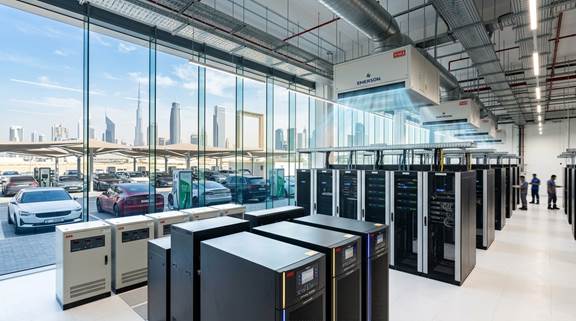
Figure 1: High-tech enterprise critical facility in Dubai showcasing server compute corridors, precision CRAC cooling units, online double-conversion UPS systems, and commercial EV charging infrastructure against the Dubai skyline.
The Rapid Expansion of Mission Critical Infrastructure in Dubai
Driven by national strategic visions including the Dubai Economic Agenda D33 and the UAE Digital Economy Strategy, enterprise data processing and critical automated infrastructure have expanded at exponential rates. Tier III and Tier IV data centers, private cloud enclaves, healthcare imaging centers, and automated industrial processing plants are deploying compute densities that routinely exceed 15 to 30 kilowatts per rack cabinet. At these high power densities, the margin for operational error drops to zero. A loss of cooling airflow for just ninety seconds can cause processor junction temperatures to spike past critical thermal limits, triggering automatic thermal shutdowns and irreversible semiconductor degradation.
To satisfy international uptime availability standards, such as 99.982% for Tier III or 99.995% for Tier IV facilities, facility directors and MEP consulting engineers can no longer treat power distribution and thermal control as isolated disciplines. Power continuity, transient voltage stabilization, precision sensible heat extraction, and galvanic electrical isolation form an inseparable engineering continuum. Selecting certified, locally supported equipment from specialized providers through dedicated certified Dubai and UAE engineering services ensures that critical assets remain fully operational, compliant with DEWA regulations, and resilient against harsh regional environmental strains.
Architecting Zero Downtime Power Distribution for High Density Facilities
The backbone of uninterrupted operations is the uninterruptible power supply architecture. In standard commercial facilities, line-interactive or passive standby systems may suffice for basic office computers. However, for enterprise server rooms, medical diagnostics suites, and automated production lines, the only acceptable standard is genuine true online double-conversion topology. By continuously rectifying incoming alternating current utility power into direct current, filtering all line noise, and subsequently regenerating a pure sinusoidal AC waveform via an insulated-gate bipolar transistor (IGBT) inverter, online double conversion UPS systems completely decouple sensitive IT hardware from raw grid disturbances.
When engineering enterprise facilities across Dubai, leading MEP designers implement mission critical UPS systems in UAE utilizing decentralized N+1 or 2N dual-bus redundant topologies. Rather than deploying massive monolithic transformers that represent single points of failure and enforce painful downtime during maintenance, modern facilities mandate scalable modular UPS configurations. These modular architectures allow individual 25kW, 50kW, or 100kW power modules to be hot-swapped in under ten minutes without transferring the critical load to raw bypass, delivering 96.5% double-conversion efficiency and preserving full electrical protection 365 days a year.
Eliminating Destructive Grid Voltage Fluctuations with Servo Stabilizers
While Dubai’s primary utility network operated by DEWA is widely recognized for world-class generation capacity, heavy industrial districts, such as Al Quoz, JAFZA, Ras Al Khor, and Dubai Industrial City, experience severe local power quality anomalies. The rapid cycling of massive inductive loads, including chiller central plants, injection molding presses, overhead gantry cranes, and arc welding equipment, causes recurring line voltage sags, chronic brownouts, and rapid swells. A voltage sag down to 340V on a nominal 400V three-phase feed causes electric motor windings in chiller compressors and AHU blowers to draw excessive current, creating severe internal thermal stress and premature insulation breakdown.
Relying solely on UPS batteries to filter continuous voltage fluctuations rapidly degrades battery lifecycle capacity. The engineered solution is upstream voltage conditioning deployed through certified industrial stabilizer suppliers in UAE. Terravolt’s high-speed servo-controlled voltage stabilizers employ micro-stepper motor driven variable autotransformers and series buck-boost transformers to correct line deviations within 20 milliseconds per volt. For external chiller plant yards, transformer compounds, and marine coastal substations exposed to direct solar radiation and sand infiltration, we engineer weatherproof outdoor stabilizers in UAE rated at IP54 to IP65 with dielectric mineral oil cooling. Oil-immersed units continuously dissipate heat through external cooling radiators, preventing thermal derating even when ambient air temperatures exceed 52 degrees Celsius.
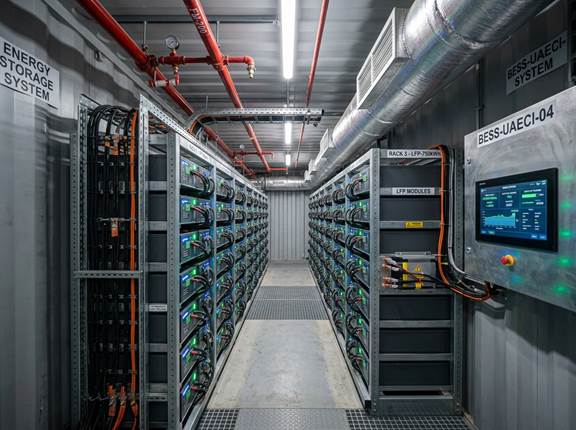
Figure 2: Enterprise energy storage and battery room featuring modular high-density lithium-ion battery racks, FM-200 clean-agent fire suppression, and digital BMS environmental monitoring.
Precision Thermal Management for Severe Arabian Gulf Heat Loads
One of the costliest engineering miscalculations in Gulf facilities is installing commercial comfort air conditioning (such as VRF or standard split units) into mission-critical server environments. Standard commercial air conditioners are engineered for human comfort: they allocate up to 35% of their total cooling capacity toward latent cooling (moisture and humidity removal) and only 65% toward sensible heat reduction. In sharp contrast, computing hardware, servers, and storage arrays generate 100% dry, sensible heat without producing moisture. Running comfort AC in a server room leads to continuous over-dehumidification, dropping relative humidity below 30% and triggering lethal electrostatic discharge (ESD) risks.
Mission-critical facilities demand specialized thermal engineering. Installing high performance CRAC units in UAE and precision cooling units in UAE guarantees a Sensible Heat Ratio (SHR) between 0.92 and 0.98. This ensures that nearly 100% of electrical energy consumed by the cooling plant directly neutralizes server heat loads. Sourced through recognized certified CCU suppliers in UAE, Terravolt’s Computer Room Air Conditioning (CRAC) and Climate Control Units (CCU) feature variable-speed electronically commutated (EC) backward-curved centrifugal fans, electronic expansion valves (EEV), and microchannel heat exchangers. These units deliver immense cubic-feet-per-minute (CFM) air volume across raised flooring plenums, maintaining stable room conditions within plus or minus 1 degree Celsius and tightly controlling relative humidity between 45% and 55% as mandated by ASHRAE TC 9.9 standards.
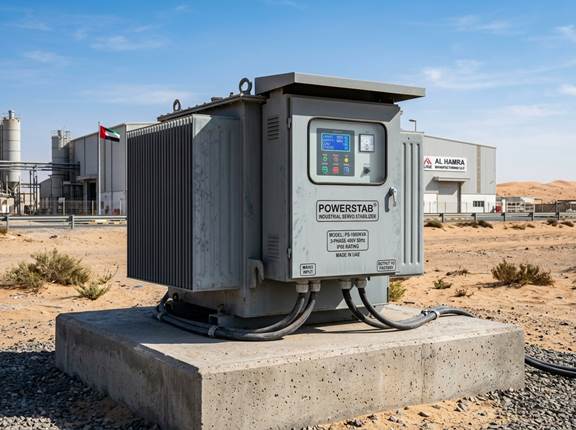
Figure 3: Heavy-duty IP55 oil-cooled outdoor servo voltage stabilizer installed in an industrial facility yard in Dubai, delivering continuous voltage stabilization under extreme ambient conditions.
Optimizing Power Usage Effectiveness in Arabian Gulf Climates
Power Usage Effectiveness (PUE) is the decisive metric governing operational expenditure in modern facilities. In moderate climates, facilities achieve PUE ratings of 1.2 to 1.3 by utilizing ambient air economization (free cooling) for several months of the year. In Dubai, however, free air cooling is completely non-viable for over eight months due to high ambient wet-bulb temperatures and particulate dust. In unoptimized facilities running obsolete equipment, PUE frequently surges above 1.8 to 2.1, meaning more electricity is expended on cooling and auxiliary overhead than on actual computing.
Achieving sub-1.35 PUE in Dubai requires an engineered, multi-faceted strategy developed through our sustainable datacenter solutions and comprehensive energy audit consultations. Key architectural interventions include total hot-aisle containment (HAC) to eliminate thermal mixing, dynamic variable-volume EC fan modulation tied to server delta-T sensors, and elevating supply air temperatures to 24-26 degrees Celsius in accordance with ASHRAE A1 allowable thresholds. Furthermore, pairing critical electrical loads with commercial rooftop solar solutions and containerized energy storage solutions enables facilities to shave expensive summer mid-day utility peaks, driving down overall operating costs while meeting mandatory UAE corporate sustainability benchmarks.
Table 1: Power Quality and Conditioning Technology Comparison for Dubai Facilities
| Equipment Class | Operating Mechanism | Grid Anomaly Addressed | Mission Critical Application in Dubai |
| Online Double-Conversion UPS | Continuous AC-DC-AC conversion with zero transfer time via IGBT inverter | Blackouts, micro-interruptions, frequency drift, voltage sags, harmonics | Enterprise server racks, cloud compute clusters, hospital operating rooms |
| Air-Cooled Servo Stabilizer | Microprocessor servo drive on toroidal autotransformer with buck-boost coil | Sustained brownouts, continuous line voltage swells, three-phase phase imbalance | Indoor electrical distribution rooms, medical imaging MRI / CT, telecom switchgear |
| Oil-Cooled Outdoor Stabilizer | Heavy-duty copper winding immersed in dielectric mineral oil (IP55/IP65) | Severe industrial line fluctuations under direct sun and high ambient heat | Chiller plant yards, heavy industrial factories, remote substation transformer feeds |
| Precision Isolation Transformer | Electrostatic shielding between galvanically isolated primary and secondary windings | Common-mode electrical noise, ground loops, neutral-to-ground voltage rise | Clean earthing for high-density computing, sensitive PLC robotics, medical labs |
| Containerized Industrial BESS | Lithium iron phosphate (LFP) battery racks with liquid thermal cooling | Utility peak demand surcharges, prolonged grid outages, solar PV shifting | Data center campus peak shaving, microgrids, industrial manufacturing continuous power |
Advanced Energy Storage and Battery Chemistries for Extended Autonomy
Energy storage is the critical bridge that preserves compute continuity between utility power failure and standby diesel generator synchronization. In the Middle East, the operational lifespan of traditional Valve-Regulated Lead-Acid (VRLA) batteries is severely compressed by ambient temperature. According to Arrhenius’ law of chemical kinetics, every 10-degree Celsius increase above the nominal 25-degree operating threshold cuts lead-acid battery design life in half. In unconditioned battery rooms or during intermittent HVAC failures, standard VRLA cells dry out, develop high internal cell resistance, and experience catastrophic thermal runaway within three years.
Partnering with trusted UPS battery suppliers in UAE allows engineering teams to deploy advanced energy storage tailored to regional requirements. Modern enterprise specifications increasingly transition toward high-rate Lithium Iron Phosphate (LiFePO4) chemistries and specialized high-temperature Gel batteries. Lithium-ion battery systems deliver a 70% reduction in physical footprint, exhibit 60% lower operating weight (essential for raised data center floors), operate reliably at elevated temperatures up to 35 degrees Celsius without accelerated aging, and provide comprehensive integrated battery management systems (BMS) with real-time cell-level impedance, voltage, and temperature telemetry.
Galvanic Isolation and Clean Earthing for Sensitive Electronic Loads
A frequently overlooked power quality vulnerability in high-density compute facilities and advanced medical centers is electrical common-mode noise and ground potential drift. When massive server power supplies and variable-frequency drives (VFDs) switch at high frequencies, they inject high-frequency harmonic currents into the shared neutral and earthing busbars. This harmonic pollution causes neutral-to-ground voltage to float upward, frequently exceeding 5 to 10 volts, corrupting high-speed serial data buses, inducing random packet loss, and damaging microchips.
Deploying a specialized medical and technical isolated power supply in UAE establishes a locally derived clean power ground (separately derived system) via an ultra-low impedance copper electrostatic shield between windings. In healthcare surgical theaters, cardiac catheterization labs, and precision pharmaceutical cleanrooms across Dubai, isolated power systems with line isolation monitors (LIM) are strictly mandatory under international standard IEC 60364-7-710 to prevent electrical leakage currents from harming vulnerable patients while ensuring continuous operation even during single fault conditions.
Integrating Commercial EV Fleet Charging into Enterprise Substation Loads
The UAE’s Green Mobility Strategy 2030 has prompted commercial enterprise campuses, business parks, and logistics hubs across Dubai to rapidly electrify their corporate vehicle and delivery van fleets. However, connecting multiple 60kW to 180kW high-speed DC fast chargers to an existing facility electrical substation creates sudden megawatt-scale demand spikes. Without intelligent load management, fleet charging can trigger substation transformer overload trips, destabilize main breaker protection, and generate severe electrical noise that impacts adjacent data center server racks.
Terravolt operates as both a leading hardware integrator and a certified charge point operator partner. Sourcing through our commercial EV charger suppliers in UAE and engaging our certified CPO licence provider in UAE enables facilities to establish DEWA-compliant smart EV infrastructure. Our dynamic load balancing algorithms dynamically adjust charging power based on real-time data center and facility energy consumption, preventing transformer overloads while facilitating automated user billing via our turnkey CPO license service.
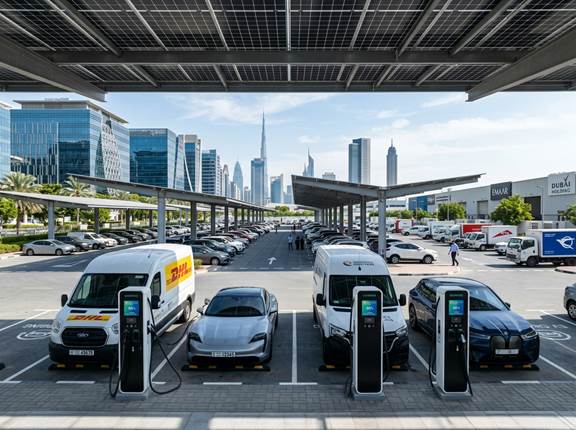
Figure 4: Commercial solar canopy EV charging hub in a Dubai commercial park, featuring DC fast chargers, fleet delivery vehicles, and dynamic grid load balancing against the Burj Khalifa skyline.
Meeting Strict DEWA Regulatory Standards and Green Building Codes
Operating critical infrastructure in Dubai requires rigorous adherence to local statutory codes, primarily enforced by Dubai Electricity and Water Authority (DEWA), Dubai Civil Defence (DCD), and Dubai Municipality’s Al Sa’fat Green Building System. Key mandatory compliance criteria include:
- DEWA Power Quality and Harmonic Distortion Limits: Under the DEWA Wiring Regulations, total harmonic distortion (THD-I) reflected back to the utility point of common coupling must remain strictly below 5%. Terravolt’s modular UPS systems feature active three-level IGBT rectifiers achieving THD-I below 3% and an input power factor above 0.99.
- Dubai Civil Defence (DCD) Fire Life Safety Regulations: Server halls and battery storage enclosures must be equipped with NFPA 2001 compliant clean-agent gaseous fire suppression (such as FM-200 or Novec 1230), intelligent early aspirating smoke detection (VESDA), and emergency power-off (EPO) interlocks with instantaneous HVAC damper isolation.
- Al Sa’fat Energy Efficiency Benchmarks: All precision cooling equipment must feature variable-frequency drive (VFD) technology or EC fans with minimum seasonal energy efficiency ratios (SEER) meeting or exceeding Dubai Municipality Tiered Green Building ratings.
Table 2: Precision Thermal Management vs Standard Commercial Air Conditioning Matrix
| Performance Metric | Precision CRAC / CCU Systems | Standard Commercial Comfort AC | Impact on Dubai Facilities |
| Sensible Heat Ratio (SHR) | 0.92 to 0.98 (sensible cooling focus) | 0.60 to 0.70 (high moisture removal) | CRAC eliminates unnecessary over-dehumidification and saves up to 38% cooling electricity |
| Airflow Velocity (CFM/kW) | 500 to 700 CFM per kW | 150 to 250 CFM per kW | High airflow eliminates hot spots in high-density server racks and prevents processor throttling |
| Operating Duty Cycle | Continuous 24/7/365 at 52°C ambient | 8-12 hours daily at moderate temperatures | Commercial units trip on high-head pressure during peak Dubai summer afternoons |
| Humidity Regulation | Active ultrasonic / electrode steam humidifier & dehumidifier | Passive humidity reduction only | Prevents static electricity discharge (ESD) in winter and condensation in summer |
| Filtration Standard | MERV 11 to MERV 14 / G4 / F7 deep-pleat | Basic washable dust mesh (MERV 4) | Guarantees clean, particulate-free air, eliminating corrosive dust buildup on circuit boards |
Why Leading Dubai Enterprises Partner with Terravolt Energy
Instead of dealing with fragmented vendors for electrical switchgear, UPS battery banks, precision air conditioning, and utility approvals, leading commercial clients across the UAE partner with Terravolt Energy Systems LLC as their unified engineering and commissioning contractor. Our competitive advantage is built upon five foundational pillars:
- Integrated Turnkey Power and Cooling Scope: We deliver complete synchronized solutions encompassing modular UPS, servo voltage stabilizers, precision CRAC cooling, and emergency electrical backup, eliminating contractor finger-pointing.
- Harsh-Environment Engineering: All systems are factory-rated and tested to operate continuously in extreme 50°C+ ambient heat, high humidity, and airborne desert particulate conditions without derating.
- Full Regulatory and Utility Compliance: Deep in-house experience managing DEWA electrical submissions, DCD civil defence permits, and municipal green building certifications across all seven emirates.
- 24/7/365 Local Field Engineering Support: Headquartered in Dubai with factory-certified field technicians, fully stocked spare parts depots, and guaranteed rapid emergency response times under custom Service Level Agreements (SLAs).
- Lifecycle Performance Monitoring: Comprehensive remote telemetry, infrared thermographic audits, semi-annual battery impedance testing, and predictive maintenance schedules that extend asset life beyond 15 years.
Frequently Asked Questions About Critical Facility Infrastructure in Dubai
Q: Why does a data center in Dubai require CRAC units instead of standard commercial air conditioning?
CRAC units are specifically designed for data centers, where nearly all heat generated by servers is sensible heat rather than moisture-related latent heat. They provide 95–98% sensible cooling, higher airflow, precise humidity control, and reliable 24/7 operation in high ambient temperatures.
Q: How often should commercial UPS batteries be inspected and replaced in the UAE?
Commercial UPS batteries should undergo internal resistance and impedance testing at least twice a year, especially in the UAE’s high-temperature environment. VRLA batteries typically require proactive replacement every 3–4 years in mission-critical facilities, while LiFePO4 systems can provide 10+ years of service.
Q: What is the difference between air-cooled and oil-cooled voltage stabilizers in Dubai?
Air-cooled servo stabilizers use forced-air cooling and are generally suitable for clean, controlled indoor environments. Oil-cooled stabilizers provide superior heat dissipation and protection from dust, sand, and corrosive conditions, making them better suited to outdoor and heavy industrial applications.
Q: What approvals are required to install commercial EV charging stations in Dubai?
Commercial EV charging installations generally require electrical design approval and a technical NOC from DEWA, along with compliance with DEWA’s EV Green Charger Technical Standards. Additional charge-point operator licensing may apply when chargers are used for public or commercial billing.
Q: How does harmonic distortion affect critical server equipment and DEWA compliance?
High harmonic distortion can cause transformer overheating, nuisance breaker trips, and power-quality problems that affect critical equipment. For UAE projects, harmonic levels must meet applicable DEWA requirements, while solutions such as active harmonic filters and low-THD UPS systems can help control distortion.
Q: Can Terravolt Energy retrofit existing facilities without shutting down live operations?
Yes, Terravolt Energy can undertake many power-conditioning, UPS, battery, and cooling upgrades while facilities remain operational. Techniques such as modular UPS systems, maintenance bypasses, and temporary load transfers can help minimize or eliminate downtime for critical loads.
