
Reliable electricity is essential for modern businesses. A short power interruption can stop production, restart servers, interrupt medical equipment, corrupt data, or shut down sensitive electronic systems. For organisations that cannot afford even a brief interruption, a UPS system in the UAE provides an important layer of protection by supplying immediate backup power and helping protect equipment from unstable electrical conditions.
UPS systems are used across offices, data centres, healthcare facilities, commercial buildings, industrial sites, server rooms, and other environments where continuity matters. Choosing the right UPS is not simply about buying a unit with a high capacity. The system must be correctly sized, installed, configured, supported by a suitable battery bank, and maintained throughout its service life.
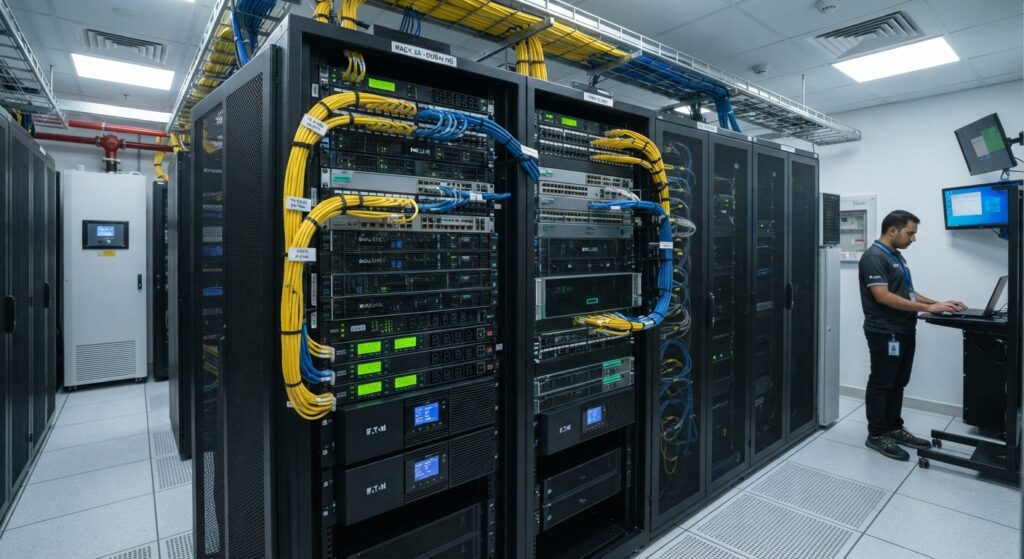
Figure 1: Modern enterprise server rack installation in the UAE featuring active double-conversion online UPS units, organized structured cabling, and real-time power monitoring displays.
What Is a UPS System?
UPS stands for Uninterruptible Power Supply. It is a power protection system designed to provide temporary backup power when the main electrical supply is interrupted. Depending on the UPS design, it can also help protect connected equipment from voltage fluctuations, electrical disturbances, and other power-quality problems.
Unlike a generator, which normally requires time to start and transfer the load, a UPS is designed to respond immediately. This makes it particularly useful for equipment that must remain operational while the main power supply is restored or while another backup source takes over.
Why Businesses in the UAE Need Reliable UPS Protection
Businesses increasingly depend on computers, networking equipment, servers, security systems, automation, medical devices, industrial controls, and other electronic equipment. Even a brief interruption can create operational and financial problems.
Operational Disruption:
Unexpected shutdowns can interrupt daily operations and reduce productivity.
Data Loss:
Servers and storage systems may be exposed to data loss or corruption during abrupt shutdowns.
Voltage Instability:
Sensitive electronic equipment can be affected by unstable voltage and power-quality issues.
Production Delays:
Industrial processes may stop unexpectedly, resulting in production delays.
Healthcare Reliability:
Medical and healthcare equipment may require continuous and stable power.
Security Impact:
Security, access-control, communication, and monitoring systems can be disrupted.
Recovery Time:
Restarting equipment after an outage can take much longer than the outage itself.
A properly selected UPS gives businesses time to ride through short interruptions and, where required, safely shut down equipment or transition to another backup source. For broader requirements, businesses often pair these systems with energy storage solutions or other services in UAE.
How a UPS Works
A UPS continuously monitors the electrical supply and supports connected equipment through its power-conversion and battery system. When the incoming supply is interrupted or falls outside the acceptable operating range, the UPS switches to its stored-energy source to keep the protected load running.
The exact operating method depends on the UPS type and system configuration. For larger and more critical installations, the design may include a dedicated battery bank, bypass arrangement, monitoring functions, and other components required for safe and reliable operation.
Types of UPS Systems
Online UPS Systems:
Online UPS systems are commonly selected for critical loads where power quality and continuity are important. They provide continuous power conditioning and are suitable for environments such as data centres, server rooms, healthcare facilities, and other sensitive applications.
Line-Interactive UPS Systems:
Line-interactive systems can provide voltage regulation and battery backup for less demanding applications. They may be appropriate for certain office equipment, networking devices, and smaller loads depending on the site’s requirements.
Standby UPS Systems:
Standby UPS units are generally used for basic backup requirements. The correct choice depends on the equipment being protected, required runtime, power quality requirements, and the consequences of an outage.
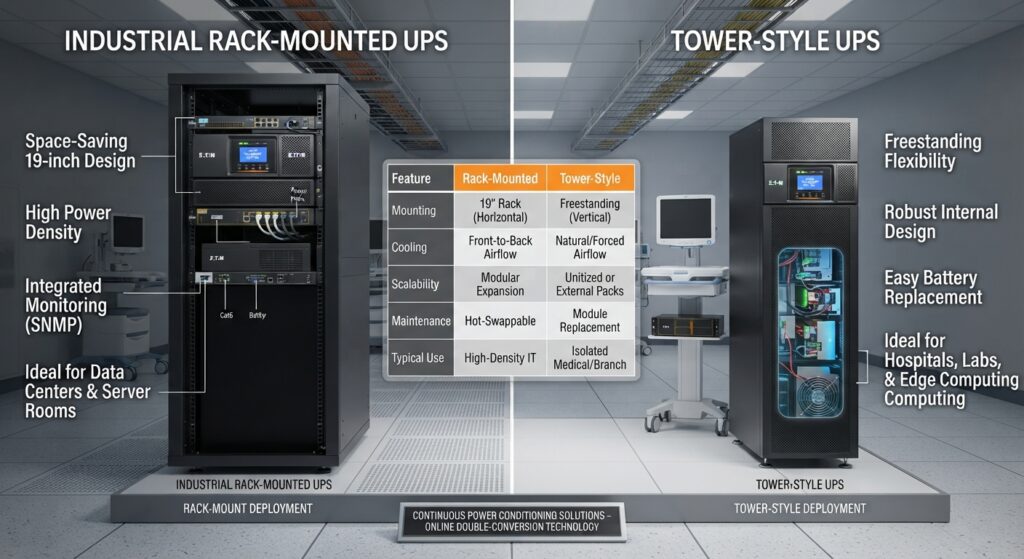 Figure 2: Comparison of industrial rack-mounted and tower-style online UPS systems designed for continuous power conditioning in sensitive IT and medical environments.
Choosing the Right UPS System in UAE
There is no single UPS solution that suits every business. The system should be selected according to the actual electrical load and the importance of the equipment being protected.
- Identify all equipment that needs backup protection.
- Calculate the connected load and expected future load.
- Determine the required backup time.
- Consider whether the load is single-phase or three-phase.
- Review the sensitivity of the equipment to voltage and power-quality problems.
- Allow reasonable capacity for future expansion rather than operating continuously at the limit.
- Consider available installation space, ventilation, battery requirements, and maintenance access.
Three-Phase UPS Systems for Larger Facilities
Three-phase UPS systems are commonly used where the protected load is larger or where the electrical distribution system requires three-phase power. They can be suitable for industrial equipment, server rooms, data centres, medical equipment, and other high-power applications.
The correct three-phase UPS should be selected after reviewing the site’s electrical architecture, connected loads, critical circuits, expansion plans, and required autonomy. A professional assessment can help avoid both undersizing and unnecessary oversizing.
UPS Sizing: Why Capacity Matters
UPS sizing is one of the most important stages of a backup-power project. A unit that is too small may overload or fail to provide the expected protection. A unit that is substantially oversized can increase the initial investment and may operate less efficiently than a properly matched system.
Sizing should consider the actual connected load, the type of equipment, startup characteristics, power factor, required runtime, and expected future growth. Businesses should also distinguish between the total electrical load and the critical load that genuinely needs uninterrupted power.
For example, an office may have printers, lighting, computers, networking equipment, and air-conditioning connected to its electrical system. It may not be necessary to place every circuit on the UPS. Protecting servers, network equipment, communication systems, and critical workstations may provide the required continuity with a more practical UPS configuration.
UPS Battery Solutions and Backup Time
The battery bank is a major part of any UPS installation because it determines how long the system can support the connected load when the main supply is unavailable. Backup time depends on factors such as battery capacity, connected load, battery condition, system efficiency, and operating conditions.
A larger battery bank does not automatically mean that every application needs longer runtime. Required autonomy should be based on the business process. Some facilities only need enough time to ride through short interruptions, while others require sufficient runtime for controlled shutdowns or coordination with a generator. You can also explore specialized industrial batteries and UPS battery suppliers in UAE for extended configurations.
Signs That UPS Batteries May Need Attention
- Noticeably reduced backup time.
- Battery alarms or repeated warning messages.
- Unexpected UPS shutdowns during relatively short outages.
- Visible battery swelling, leakage, corrosion, or other physical abnormalities.
- Aged batteries approaching their expected service period.
- Repeated battery-related faults during testing or maintenance.
UPS Installation and Commissioning
Correct installation is just as important as selecting the UPS itself. Installation should account for electrical connections, battery placement, ventilation, protection devices, bypass arrangements, cable routing, earthing, and safe access for service.
Commissioning should verify that the UPS and battery system operate correctly before the equipment is placed into normal service. This can include configuration, alarm checks, battery checks, operational testing, load verification, and confirmation that the system responds correctly under expected operating conditions.
- Step 1: Review the site’s electrical and load requirements.
- Step 2: Confirm UPS capacity and battery configuration.
- Step 3: Prepare the installation location and required electrical connections.
- Step 4: Install and connect the UPS and battery system.
- Step 5: Configure the system according to the application’s requirements.
- Step 6: Carry out operational and protection checks.
- Step 7: Test the system under suitable load conditions.
- Step 8: Document the configuration and hand over the system for operation and maintenance.
UPS Maintenance and AMC
A UPS should not be treated as a fit-and-forget appliance. Regular maintenance helps identify developing problems before they become failures. This is particularly important for facilities where an unexpected loss of backup power could affect business operations or critical equipment.
- Inspect UPS alarms and operating status.
- Check battery condition and backup performance.
- Inspect connections and relevant electrical components.
- Review operating temperature and ventilation.
- Check for abnormal noise, overheating, or unusual behaviour.
- Review system logs and fault indications where available.
- Test relevant backup functions according to the maintenance plan.
- Replace ageing or failed batteries and components when required.
An annual maintenance contract (AMC) can provide scheduled inspections and technical support, helping businesses maintain their UPS equipment and respond more quickly when faults occur.
Common UPS Problems Businesses Should Not Ignore
A UPS may provide warning signs before a complete failure. Ignoring these signs can leave critical equipment unprotected when the next power interruption occurs.
- Frequent overload warnings.
- Battery alarms or declining runtime.
- Repeated bypass operation.
- Unexpected shutdowns.
- Persistent fault codes.
- Excessive heat or unusual fan behaviour.
- Abnormal sounds or physical signs around the battery system.
- A UPS that no longer supports the load for the expected duration.
When these issues occur, the cause should be investigated rather than repeatedly resetting the system. Depending on the fault, the solution may involve battery replacement, load correction, configuration changes, component repair, or a broader assessment of the UPS installation.
UPS Repair and Technical Support
Technical support is important when a UPS develops an alarm, battery problem, overload condition, or other operational fault. Professional troubleshooting can help identify whether the issue is related to the UPS, batteries, connected load, electrical distribution, or system configuration.
For critical installations, businesses should consider response time, spare-parts availability, maintenance capability, and the supplier’s experience with the specific UPS application when selecting technical support.
Where UPS Systems Are Used
- Offices and Commercial Buildings: UPS systems can protect servers, network switches, communication equipment, computers, security systems, and other critical office infrastructure. The goal is to keep essential operations running and prevent abrupt shutdowns.
- Data Centres and Server Rooms: Data centres require high levels of power continuity. UPS systems can help protect servers, storage, networking equipment, and other IT infrastructure from interruptions and power-quality issues. Battery runtime and redundancy requirements should be considered carefully during system design.
- Healthcare Facilities: Healthcare environments may rely on electronic and medical equipment that requires stable and continuous power. UPS selection should be based on the specific equipment, criticality, electrical design, and applicable facility requirements.
- Industrial Facilities: Industrial sites may use UPS systems for control systems, automation, instrumentation, communications, monitoring, and other equipment where an unexpected shutdown can interrupt production or create operational risks.
UPS vs. Generator: Do You Need Both?
A UPS and a generator perform different roles and can work together. A UPS provides immediate backup and power conditioning for critical equipment, while a generator can provide longer-duration backup when utility power is unavailable for an extended period.
For a facility with critical operations, the UPS can keep sensitive loads running while the generator starts and stabilises. This combination can provide both immediate continuity and extended backup capability.
Figure 3: Schematic architecture illustrating how an uninterrupted power supply (UPS) instantly bridges the critical transition gap between a grid power failure and backup generator startup.
Improving UPS Efficiency and Operating Costs
A well-designed UPS installation should provide the required protection without unnecessarily increasing operating costs. Businesses can improve efficiency by correctly sizing the system, avoiding persistent overload or very light operation where possible, maintaining batteries properly, keeping ventilation clear, and reviewing the critical load as the facility changes.
Load growth should also be considered. If additional servers, equipment, or production machinery are expected in the future, the UPS design should allow for realistic expansion or a planned upgrade path.
What to Check Before Buying a UPS in UAE
- What equipment must remain operational during an outage?
- What is the total critical load?
- Is the load single-phase or three-phase?
- How much backup time is required?
- Is a generator available or planned?
- Where will the UPS and batteries be installed?
- What environmental and ventilation conditions apply?
- What maintenance and technical support will be available?
- What battery replacement strategy will be followed?
- Is future load expansion expected?
Why Choose Terravolt Energy for UPS Solutions in the UAE?
Terravolt Energy provides comprehensive services in UAE, including dedicated UPS systems in UAE for offices, data centres, healthcare facilities, commercial buildings, and industrial sites. Its UPS services cover system sizing, installation and commissioning, battery solutions, maintenance, repair, and technical support.
The focus should be on matching the UPS configuration to the actual application rather than selecting equipment based only on capacity. Businesses can discuss their protected equipment, current load, and required backup time with Terravolt to determine a suitable approach.
A Practical Example: Protecting a Small Server Room
Consider a business with a server room containing servers, network switches, storage equipment, and communication hardware. A sudden outage could interrupt internal systems and potentially cause an uncontrolled shutdown.
A suitable UPS design would begin by identifying the critical equipment and measuring its load. The required backup duration would then be established. If the business has a generator, the UPS may only need enough battery capacity to bridge the period until generator power is available. If no generator exists, the battery requirement may be based on the desired runtime and shutdown procedure.
The system would then be installed, commissioned, tested, and maintained so that the business can rely on it when a power interruption occurs.
How to Get Started With a UPS System in UAE
The best starting point is to understand the equipment that needs protection. Prepare a list of critical loads, their approximate power requirements, the desired backup time, and whether the facility has a generator or other backup source.
From there, a UPS specialist can assess the application and recommend an appropriate system configuration, including UPS capacity, battery requirements, installation approach, and maintenance plan.
Conclusion
A UPS system in the UAE can play a critical role in protecting business operations from unexpected power interruptions, voltage issues, and uncontrolled equipment shutdowns. The right solution depends on the application’s load, required backup time, electrical configuration, equipment sensitivity, and future expansion plans.
From three-phase UPS systems and battery solutions to installation, commissioning, maintenance, and technical support, every part of the system contributes to reliability. Businesses should therefore look beyond the initial purchase and consider the complete life cycle of the UPS.
If you are planning a UPS installation or upgrading an existing system, share the equipment you need to protect, your current load, and the required backup time with Terravolt Energy. This information can help determine a practical UPS solution for your facility in the UAE.
Frequently Asked Questions About UPS Systems in UAE
How long can a UPS provide backup power?
Backup time depends on the connected load and battery capacity. A higher load generally consumes battery energy faster, while a larger battery configuration can provide longer runtime.
Are three-phase UPS systems suitable for large facilities?
Yes. Three-phase UPS systems are commonly used for larger electrical loads and applications such as industrial facilities, data centres, server rooms, and medical equipment.
Can batteries be replaced in an existing UPS?
In many cases, existing UPS systems can continue to be used with compatible replacement or upgraded batteries. Compatibility and system condition should be checked before replacement.
Does a UPS replace a generator?
Not necessarily. A UPS provides immediate backup and power protection, while a generator is generally intended for longer-duration backup. The two systems can be used together.
How often should a UPS be maintained?
Maintenance frequency depends on the UPS, batteries, application, operating environment, and manufacturer’s requirements. Regular inspections help identify battery deterioration, alarms, overheating, and other developing issues.
What information is needed to size a UPS?
Useful information includes the equipment to be protected, connected load, phase configuration, required backup time, future load growth, and whether another backup source such as a generator is available.
Can Terravolt Energy install and commission UPS systems in the UAE?
Terravolt Energy provides UPS system sizing, installation and commissioning, battery solutions, maintenance, repair, and technical support for businesses across the UAE.
